
Training in the correct way can be confusing at first
You’d think that anyone who takes the time to train would like their time to be effectively spent and to get the best results possible. However, many gym-goers make mistakes that can render workouts ineffective, hinder progress or even cause injury.
Of course, anyone new to training or a gym environment will be unsure of what to do, but it’s not uncommon for people who’ve been training for years to make errors.
Below are some of the more common workout mistakes. If you’re new to training or the gym environment the points below will provide a good foundation for a solid and productive workout. If you’ve been training for years you might learn something new, too!
There’s quite a lot to take in here if you’re new to training but the points below should provide a good foundation for progress. If you’re stuck or have any queries please feel free to contact me. If you’re not sure about any of the terms used in this article, please refer to our glossary of fitness terms.
Too much time between sets
People often start daydreaming and take too much time between sets which means they’re not working their muscles hard enough and they’re stretching what could be an effective 30 minute workout into a less-effective 1 hour workout. You especially see this when groups of people are training together and have 5 minute chats between sets.
Giving yourself a set amount of rest time between sets, 1 minute for example, gives your workout structure, keeps your training time down, increases effectiveness and keeps your training consistent between sessions.
If you’re doing 15+ reps (for muscle endurance) then you should take a rest of 30 seconds – 1 minute between sets. 8-12 reps (muscle hypertrophy) should be about 1-2 minutes and for 1-6 reps (muscle strength) about 2-4 minutes.
If you reduce the amount of rest time between your sets, your workout will be harder and more intense. I personally time 1 minute between sets of 8-10 reps.
Lifting excessively heavy weight
This is one you’re guaranteed to see in any gym – guys throwing massive weights around with terrible form as quick as they can. Whether it’s through ignorance or just to show off, lifting weights too heavy for you is counter-productive and dangerous. Build your weight up slowly and focus on avoiding our next common mistake, which is…
Poor Technique
A classic example of an exercise that’s commonly executed with poor technique is the lat pulldown, with guys leaning back and jerking the weight towards them using the momentum. It’s this kind of movement which means the rights muscles aren’t worked and the risk of injury is increased.
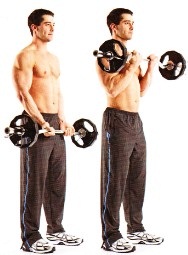
A bicep curl performed correctly - many people lean back and lift the elbows which is counter-productive and can be dangerous
My advice would be to put pride to one side and rather than increasing the weight you’re lifting try slowing down the movement to 2 seconds up/out, 2 seconds down/in. Concentrate on good form so that the muscles that are supposed to be working are powering the move. For example, in a bicep curl ensure it’s the bicep that is lifting the weight and it’s only your forearms moving, rather than leaning back and lifting the elbows up or out for extra help. If you’re doing all this and still able to lift the weight in your desired rep range (for me, 8-10 reps), it’s time to progress and up the weight!
Lifting too little weight
You more commonly see this from women who are scared about bulking up and becoming too big, a common misconception. Check out our article on this… but this point is also aimed at anyone who’s not pushing themselves hard enough. To progress and reach your fitness goals you need to push your body beyond what it can comfortably do.
Working out too long
You often hear guys boasting of a 2 hour weight workout in the gym. This simply means they haven’t been pushing themselves hard enough and have probably been watching the gym TV or chatting to their mates between sets. If you follow the above advice by pushing yourself and keeping time between activity to a minimum, a weight training session should not go beyond an hour. If you work hard and are clever you can squeeze a solid chest or arms workout into 20 minutes, which will come as a relief to people who have busy lifestyles or don’t like spending too much time in the gym!
Overtraining, not taking a break
If you work a muscle group to absolute fatigue then it will take about a week before you can effectively work these muscles again. It’s during this week that your muscles are growing stronger and bigger so to train them hard again during this period can stunt growth and be counter productive. Training too often risks Overtraining Syndrome (OTS) which can cause injury, a weakened immune system, tiredness or general fatigue. This doesn’t mean you can only train once a week, but it means you have to structure your training so that your body is getting adequate rest, for example, by splitting your training into different body parts on different days, or by mixing up your types of training.
If you’ve been working out constantly for months without a break, try having a week off with some stretching and healthy eating. You might find that you’ll feel better, more motivated and you can break through your training plateaus on your return.
Just working chest and biceps and neglecting legs and core
Some newcomers to the gym think that being in good shape means having a big chest and biceps. In reality, this leads to an unbalanced look that pulls your posture out of a healthy and natural alignment. Each muscle has an opposite muscle that has to be worked equally, so as you build your chest muscles you must also build and strengthen your back muscles. Not doing this results in your shoulders being pulled forward and so poor posture and strain on the spine, which isn’t good.
Of course, overly focusing on some areas means neglecting others. I’d say most guys rarely work legs, which can lead to ‘Chicken Leg Syndrome’ – having a developed upper body but tiny legs that are out of proportion.
This learning point can be summarised by saying that workouts should be balanced. Whether you’re training for vanity or health there’s no excuse for not balancing out your workout to cover all areas. If you train purely for vanity (and there’s nothing wrong with that) you will look much stronger, healthier and ultimately more attractive if you’re well proportioned. Most people will think you look ridiculous if you have huge biceps but small legs so if you’re training to look good it pretty much defeats the point. If you’re training for health, then having a strong balanced body will help prevent injuries, back pain and will make you a more functional and all-round healthy person!
Always doing the same workout
Some people don’t like change, and so stick to the same workout that they know and love for years on end. By not mixing up your workout your body will get used to working in a certain way and so it will cease to develop and progress. Your muscles need to be ‘shocked’ by hitting them in different ways, so if you find you’ve hit a plateau and you’re not improving then it’s time to try something new. A few ways to mix things up can be: changing your grip, using free weights or cables instead of machines or by using some more advanced methods such as dropsets. It’s generally advised that you vary your routine at least once every 4-6 weeks, but I would encourage more often than this.
Too many isolation exercises
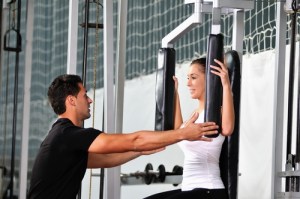
Some guidance when you start can really help
Compound exercises which work more than one muscle group should make up the bulk of your workout. Some people focus on too many isolation exercises which only work one muscle and joint, for example a bicep curl which just works the bicep. By doing more compound exercises (such as a squat which works quadriceps, hamstrings, glutes, lower back, calves, abductors and abdominals) you’re training your body’s muscles to work well together which is conducive to good growth and development. Isolation exercises do have their place, but you should do compound exercises at the start of a workout before moving onto isolation work.
Not warming/cooling down and not stretching
Another common mistake that many people are aware of but neglect anyway. By warming up the body first by some pulse raising activity and dynamic stretching you’re less likely to injure yourself and your body will be more prepared for the hard work ahead. Cooling down afterwards is also important to bring your heart rate down slowly which prevents blood pooling.
Stretching your muscles after they’ve been working hard is very important for a variety of reasons. Not many people enjoy it but stretching improves flexibility and posture, increases your range of movement which in turn improves sporting performance and day-to-day functionality, reduces muscle soreness and fatigue, aids recovery, decreases your chance of injury and increases definition in your muscles. If one or all of these things are important to you then you need to introduce stretching into your program.
Holding your breath
You should breath out in the positive phase of an exercise (pushing/pulling the weight) and breath in during the negative phase (lowering the weight). There is a tendency amongst newcomers to hold their breath which increases blood pressure and can cause fainting.
Trying to spot reduce certain areas
You cannot work out to reduce weight in a certain area, such as abs or hips. Put another way, doing loads of crunches and ab work alone will not give you a six-pack; a good diet and regular aerobic exercise need to be incorporated into your routine for best results and an overall toned and defined physique.
Not drinking enough water
If you feel thirsty then you’re already dehydrated. Keep well hydrated during your training and you’ll be able to work at optimal levels. Stay well hydrated by drinking 2-3 cups of water in the two hours preceding exercise and roughly a cup of water every 15 minutes during exercise. Hydrate yourself with water or low-sugar sports drinks (less than 8g carbohydrates per 100ml).
Leaving weights out, gym etiquette
This is a personal pet hate of mine and you see this from people who’ve been training for decades. When you’ve finished using your weights or equipment, put it back in its rack. When you’ve finished with a barbell, take the weights off the bar as the next person using it may be unable to do so. Leaving weights lying around is dangerous as other people can trip over them, and it shows no respect for other people or for the gym. Don’t be that person.
Fun, efficient and effective Bangkok workouts – summary
A 20 minute workout done right can be far more effective than a 60 minute workout done poorly. There may seem like a lot to take in here but by following these principles your workouts will be more efficient and effective, and after a while you will habitually and automatically apply them to your training.
I hope this article has helped you and please feel free to contact me if you have any queries about training.
Have fun!





 Bangkok Personal Trainer, Health, Fitness, Diet, Bootcamp, Football and Sport