14 common gym mistakes

Training in the correct way can be confusing at first

You’d think that anyone who takes the time to train would like their time to be effectively spent and to get the best results possible. However, many gym-goers make mistakes that can render workouts ineffective, hinder progress or even cause injury.

Of course, anyone new to training or a gym environment will be unsure of what to do, but it’s not uncommon for people who’ve been training for years to make errors.

Below are some of the more common workout mistakes. If you’re new to training or the gym environment the points below will provide a good foundation for a solid and productive workout. If you’ve been training for years you might learn something new, too!

There’s quite a lot to take in here if you’re new to training but the points below should provide a good foundation for progress. If you’re stuck or have any queries please feel free to contact me. If you’re not sure about any of the terms used in this article, please refer to our glossary of fitness terms.

Too much time between sets

People often start daydreaming and take too much time between sets which means they’re not working their muscles hard enough and they’re stretching what could be an effective 30 minute workout into a less-effective 1 hour workout. You especially see this when groups of people are training together and have 5 minute chats between sets.

Giving yourself a set amount of rest time between sets, 1 minute for example, gives your workout structure, keeps your training time down, increases effectiveness and keeps your training consistent between sessions.

If you’re doing 15+ reps (for muscle endurance) then you should take a rest of 30 seconds – 1 minute between sets. 8-12 reps (muscle hypertrophy) should be about 1-2 minutes and for 1-6 reps (muscle strength) about 2-4 minutes.

If you reduce the amount of rest time between your sets, your workout will be harder and more intense. I personally time 1 minute between sets of 8-10 reps.

Lifting excessively heavy weight

This is one you’re guaranteed to see in any gym – guys throwing massive weights around with terrible form as quick as they can. Whether it’s through ignorance or just to show off, lifting weights too heavy for you is counter-productive and dangerous. Build your weight up slowly and focus on avoiding our next common mistake, which is…

Poor Technique

A classic example of an exercise that’s commonly executed with poor technique is the lat pulldown, with guys leaning back and jerking the weight towards them using the momentum. It’s this kind of movement which means the rights muscles aren’t worked and the risk of injury is increased.
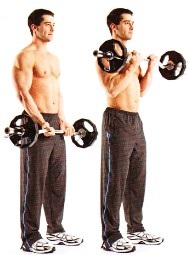
A bicep curl performed correctly - many people lean back and lift the elbows which is counter-productive and can be dangerous

My advice would be to put pride to one side and rather than increasing the weight you’re lifting try slowing down the movement to 2 seconds up/out, 2 seconds down/in. Concentrate on good form so that the muscles that are supposed to be working are powering the move. For example, in a bicep curl ensure it’s the bicep that is lifting the weight and it’s only your forearms moving, rather than leaning back and lifting the elbows up or out for extra help. If you’re doing all this and still able to lift the weight in your desired rep range (for me, 8-10 reps), it’s time to progress and up the weight!

Lifting too little weight

You more commonly see this from women who are scared about bulking up and becoming too big, a common misconception. Check out our article on this… but this point is also aimed at anyone who’s not pushing themselves hard enough. To progress and reach your fitness goals you need to push your body beyond what it can comfortably do.

Working out too long

You often hear guys boasting of a 2 hour weight workout in the gym. This simply means they haven’t been pushing themselves hard enough and have probably been watching the gym TV or chatting to their mates between sets. If you follow the above advice by pushing yourself and keeping time between activity to a minimum, a weight training session should not go beyond an hour. If you work hard and are clever you can squeeze a solid chest or arms workout into 20 minutes, which will come as a relief to people who have busy lifestyles or don’t like spending too much time in the gym!

Overtraining, not taking a break

If you work a muscle group to absolute fatigue then it will take about a week before you can effectively work these muscles again. It’s during this week that your muscles are growing stronger and bigger so to train them hard again during this period can stunt growth and be counter productive. Training too often risks Overtraining Syndrome (OTS) which can cause injury, a weakened immune system, tiredness or general fatigue. This doesn’t mean you can only train once a week, but it means you have to structure your training so that your body is getting adequate rest, for example, by splitting your training into different body parts on different days, or by mixing up your types of training.

If you’ve been working out constantly for months without a break, try having a week off with some stretching and healthy eating. You might find that you’ll feel better, more motivated and you can break through your training plateaus on your return.

Just working chest and biceps and neglecting legs and core

Some newcomers to the gym think that being in good shape means having a big chest and biceps. In reality, this leads to an unbalanced look that pulls your posture out of a healthy and natural alignment. Each muscle has an opposite muscle that has to be worked equally, so as you build your chest muscles you must also build and strengthen your back muscles. Not doing this results in your shoulders being pulled forward and so poor posture and strain on the spine, which isn’t good.

Of course, overly focusing on some areas means neglecting others. I’d say most guys rarely work legs, which can lead to ‘Chicken Leg Syndrome’ – having a developed upper body but tiny legs that are out of proportion.

This learning point can be summarised by saying that workouts should be balanced. Whether you’re training for vanity or health there’s no excuse for not balancing out your workout to cover all areas. If you train purely for vanity (and there’s nothing wrong with that) you will look much stronger, healthier and ultimately more attractive if you’re well proportioned. Most people will think you look ridiculous if you have huge biceps but small legs so if you’re training to look good it pretty much defeats the point. If you’re training for health, then having a strong balanced body will help prevent injuries, back pain and will make you a more functional and all-round healthy person!

Always doing the same workout

Some people don’t like change, and so stick to the same workout that they know and love for years on end. By not mixing up your workout your body will get used to working in a certain way and so it will cease to develop and progress. Your muscles need to be ‘shocked’ by hitting them in different ways, so if you find you’ve hit a plateau and you’re not improving then it’s time to try something new. A few ways to mix things up can be: changing your grip, using free weights or cables instead of machines or by using some more advanced methods such as dropsets. It’s generally advised that you vary your routine at least once every 4-6 weeks, but I would encourage more often than this.

Too many isolation exercises
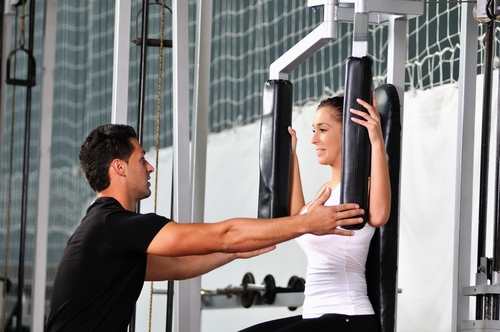
Some guidance when you start can really help

Compound exercises which work more than one muscle group should make up the bulk of your workout. Some people focus on too many isolation exercises which only work one muscle and joint, for example a bicep curl which just works the bicep. By doing more compound exercises (such as a squat which works quadriceps, hamstrings, glutes, lower back, calves, abductors and abdominals) you’re training your body’s muscles to work well together which is conducive to good growth and development. Isolation exercises do have their place, but you should do compound exercises at the start of a workout before moving onto isolation work.

Not warming/cooling down and not stretching

Another common mistake that many people are aware of but neglect anyway. By warming up the body first by some pulse raising activity and dynamic stretching you’re less likely to injure yourself and your body will be more prepared for the hard work ahead. Cooling down afterwards is also important to bring your heart rate down slowly which prevents blood pooling.

Stretching your muscles after they’ve been working hard is very important for a variety of reasons. Not many people enjoy it but stretching improves flexibility and posture, increases your range of movement which in turn improves sporting performance and day-to-day functionality, reduces muscle soreness and fatigue, aids recovery, decreases your chance of injury and increases definition in your muscles. If one or all of these things are important to you then you need to introduce stretching into your program.

Holding your breath

You should breath out in the positive phase of an exercise (pushing/pulling the weight) and breath in during the negative phase (lowering the weight). There is a tendency amongst newcomers to hold their breath which increases blood pressure and can cause fainting.

Trying to spot reduce certain areas

You cannot work out to reduce weight in a certain area, such as abs or hips. Put another way, doing loads of crunches and ab work alone will not give you a six-pack; a good diet and regular aerobic exercise need to be incorporated into your routine for best results and an overall toned and defined physique.

Not drinking enough water

If you feel thirsty then you’re already dehydrated. Keep well hydrated during your training and you’ll be able to work at optimal levels. Stay well hydrated by drinking 2-3 cups of water in the two hours preceding exercise and roughly a cup of water every 15 minutes during exercise. Hydrate yourself with water or low-sugar sports drinks (less than 8g carbohydrates per 100ml).

Leaving weights out, gym etiquette

This is a personal pet hate of mine and you see this from people who’ve been training for decades. When you’ve finished using your weights or equipment, put it back in its rack. When you’ve finished with a barbell, take the weights off the bar as the next person using it may be unable to do so. Leaving weights lying around is dangerous as other people can trip over them, and it shows no respect for other people or for the gym. Don’t be that person.

Fun, efficient and effective Bangkok workouts – summary

A 20 minute workout done right can be far more effective than a 60 minute workout done poorly. There may seem like a lot to take in here but by following these principles your workouts will be more efficient and effective, and after a while you will habitually and automatically apply them to your training.

I hope this article has helped you and please feel free to contact me if you have any queries about training.

Have fun!
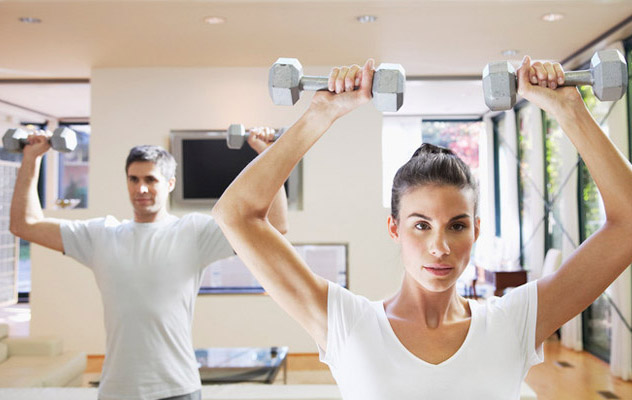
Top 10 list of home workout kit

Working out at home can be equally as effective as training at a gym

Working out at home is becoming an increasingly popular way to keep fit. Gym memberships can be expensive and often provide an uncomfortable or intimidating environment, especially during peak hours when they can be overcrowded.

Working out at home can be fun, time-efficient and equally as effective as going to a gym.

If you’re considering training at home you may not be sure of how to approach it. Home workouts require a little more effort in constructing your workout and getting motivated.

You may be wondering what home workout kit you’ll need. This can be difficult to decide as the fitness market is flooded with gadgets, supplements, ab machines and expensive kit, all claiming to be the ‘next big thing’ and the only way to lose weight or get an impressive physique.

With all these over-priced gadgets and gimmicks, knowing what to get for home workouts can be a minefield.

To help you out, I’ve compiled a top 10 list of home workout kit. Each piece of kit is ranked for effectiveness, cost and ease of use, each given a mark out of 10. I’ve also given a mark for how fun and travel-friendly they are, in case you want to take them on holiday or on a business trip.

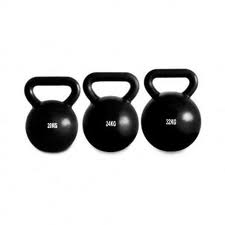
Kettlebells

Kettlebells are awesome. They’re versatile and work your body in a way that traditional gym workouts can’t.

They’re pretty cost-effective at about 30USD (1,000THB) per kettlebell and they last forever. However, if you’ve never used kettlebells before or you’re not used to the type of ballistic movement they require then we’d advise getting some guidance from a professional and progressing slowly until you’re used to the moves. Don’t let this put you off though – Kettlebells are absolutely worth learning!

Kettlebells are pretty heavy though, so not easy to travel with unless you only use a light one.

Check out our Kettlebell article for more info and videos.

Effectiveness 10   Cost 7   Ease of use 3   Travel-friendly 2   Fun 8

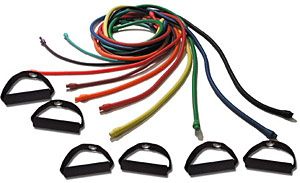
Resistance Bands

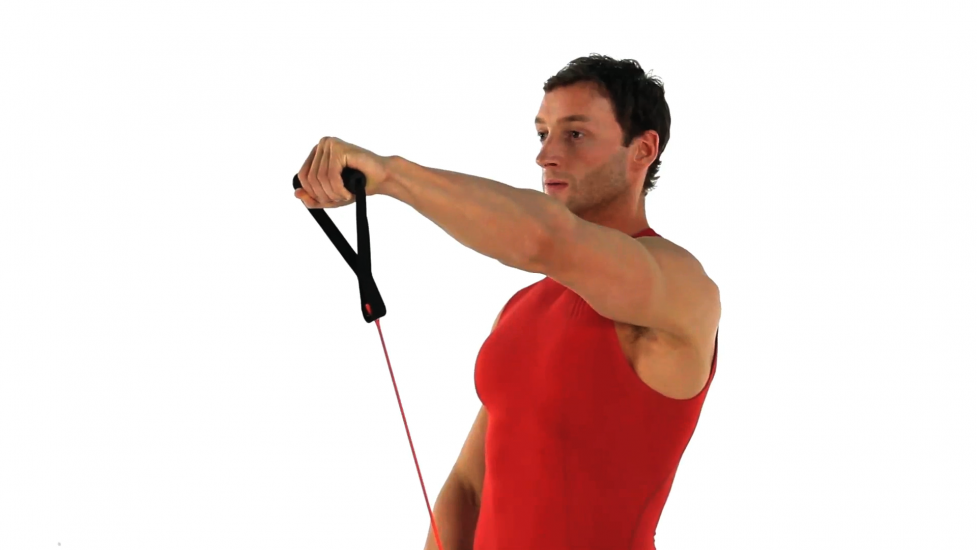
Resistance bands are another great piece of kit that are easy and fun to use and are super-light. Every muscle group can be worked with the bands by hanging or hooking them onto something sturdy or by standing on them. For example, standing on the resistance bands and lifting your arm straight out in front of you works your shoulders (see pic). Hook the bands around a tree or pole and pull the handles towards you for a ‘row’ back exercise.

You can stand on the bands or hook them around something to do a variety of exercises

Resistance can be changed by shortening the band length or using different tension bands which come in different colours.

Resistance bands are cheap, costing around 30-50USD (1,000 – 1,500THB) for a set. They can easily be thrown in a suitcase so you can keep active while away and they’re easy to get the hang of. However, if you’re used to using heavy weights these may not provide the intensity and level of workout you’re used to.

Effectiveness 7   Cost 9   Ease of use 8   Travel-friendly 9   Fun 7

Swiss Ball

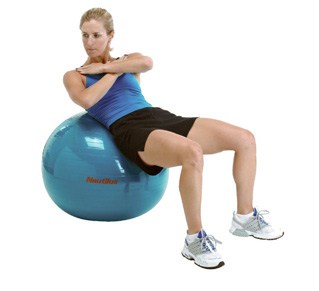
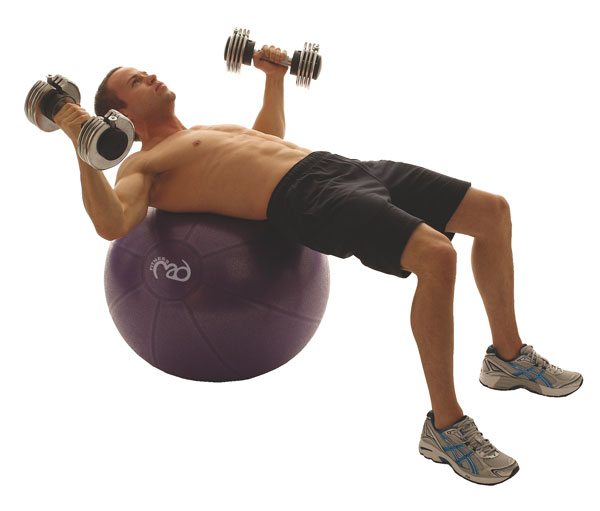
Aka stability ball, balance ball or exercise ball. Swiss balls are essentially large inflated plastic balls. They can be used to make standard exercises harder, for example, if you perform a press up with your feet on a swiss ball, your body and core muscles will have to work harder to stabilize and stop your feet from falling off. There are thousands of exercises that can be done on this versatile piece of kit which we’ll look at more closely in a future article.

Dumbbell chest press on a swiss ball

They are a bit of a hassle to deflate and inflate, but could be packed up reasonably easily. Some people advocate sitting on a swiss ball when on a computer, the theory being that your core and abdominals will be engaged to ensure balance and correct posture.

Swiss balls are cheap and most department stores and sports shops in Bangkok and elsewhere should stock them.

Effectiveness 7   Cost 10   Ease of use 7   Travel-friendly 6   Fun 7

TRX

TRX are pretty new on the fitness scene and use a concept that’s simple, but very effective.

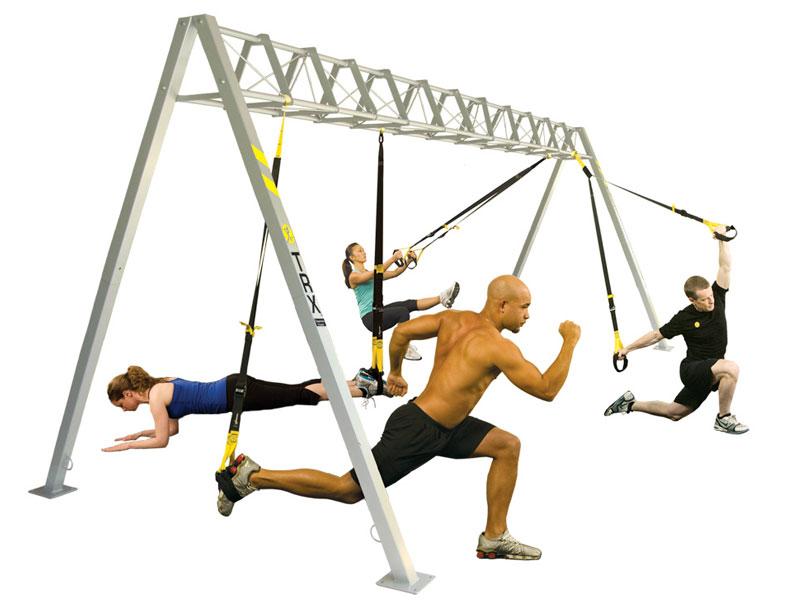
Marketed as ‘suspension training’, TRX is essentially a non-elastic band made of strong nylon webbing with two handles at each end of the band. The TRX can be hooked onto anything or onto a door support which leaves the handles suspended. By gripping the handles or hooking your feet into them a huge variety of exercises can be performed.

Workouts can be made easier or harder by adjusting body position and the height of TRX handles. By adjusting the way exercises are performed it can be suitable for light rehabilitation, hardcore workouts or anything in-between.

Row with suspended TRX to work the back and biceps

TRX is not cheap, but is very light and travels easily. Some beginners would probably need guidance from a trainer or DVD/manual, but once you’re used to it you can make your own exercises up.

A great piece of versatile kit, but pretty expensive with prices starting at about 180USD (6,000THB) for a basic set.

Currently they cannot be purchased in Thailand but some gyms in Bangkok, such as Total Body Fitness, have them in their studio.

Effectiveness 9   Cost 3   Ease of use 6   Travel-friendly 10   Fun 9

ViPR

If you tried a ViPR workout in your home you’d probably end up smashing the place to pieces, so it’s fair to say ViPR is more suitable for a garden workout.

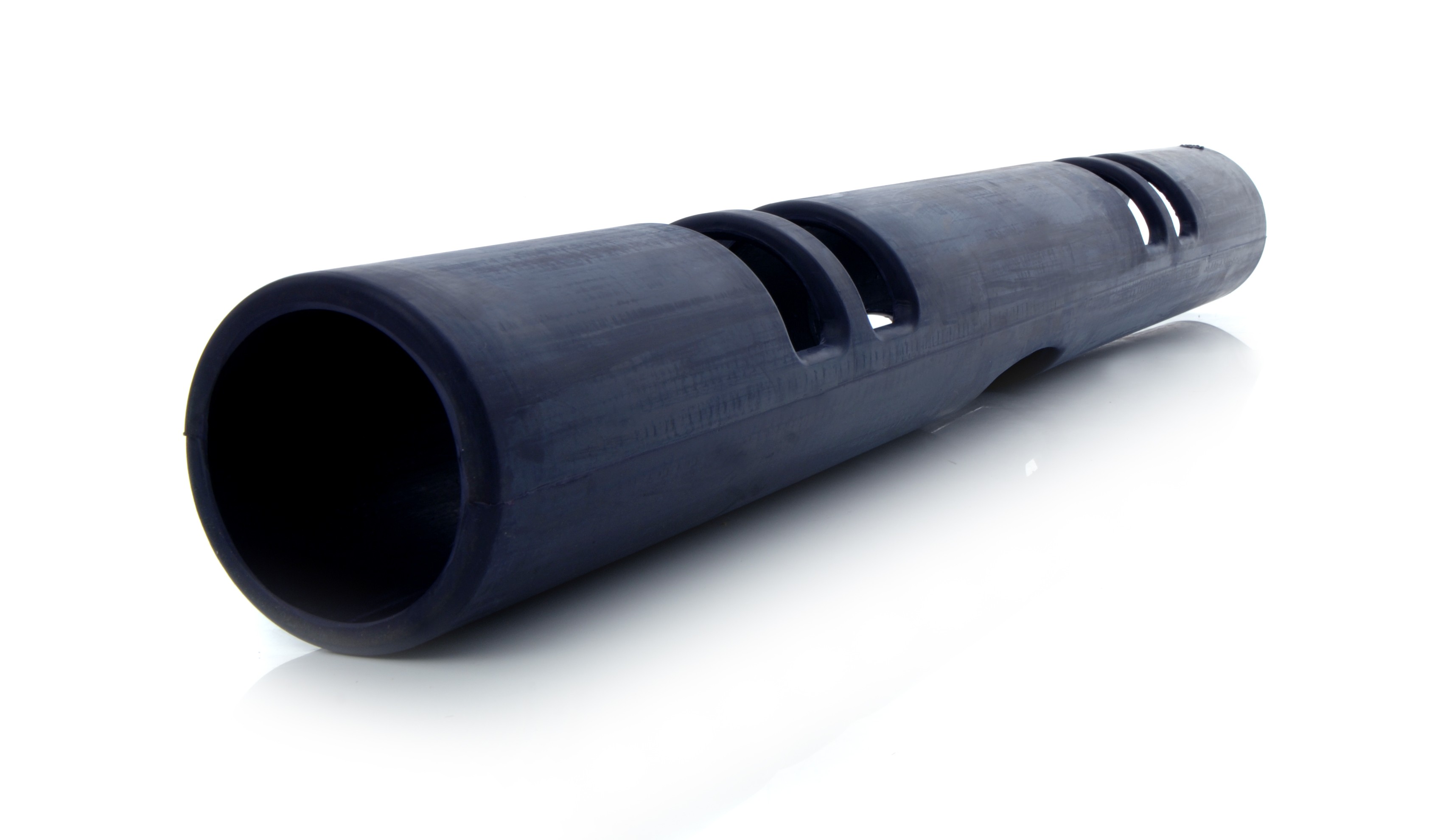
ViPR stands for Vitality, Performance and Reconditioning and is essentially a hollow rubber tube with handles (see pic). It’s this shape that makes ViPR incredibly versatile for lifting, explosive exercises, ballistic movements and CV work.

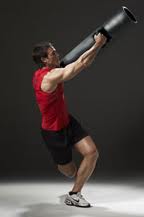
Dynamic ViPR movements prepare you for sport

ViPR is hugely popular with everyone I know who’s tried it. They’re great for a beginner or someone who finds working out monotonous, and they are genuinely used by many sportsmen and athletes to improve functional fitness. But like TRX and kettlebells, a lot of people may not quite know what to do with it without some guidance.

Their size makes them not really suitable for taking on holiday and the cost is pretty steep, starting at about 140USD (4,000THB) for the lightest 4kg ViPR. However, If you can afford it and you have the room, they’re definitely worth it.

Effectiveness 10   Cost 3   Ease of use 5   Travel-friendly 1   Fun 10

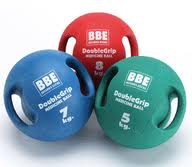
Medicine Ball

They sometimes come with handles to facilitate certain movements

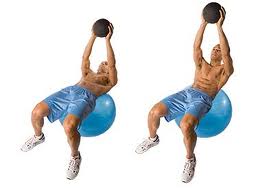
Medicine balls are football sized balls that weigh anything from 1kg – 15kg+ and can be used to make exercises harder. For example, you can hold a medicine ball whilst performing tab crunches, or you can twist your torso from side to side while holding the ball to work your obliques (side abdominal muscles).

They’re quite well-known for being used in boxing training with the medicine ball being thrown into the stomach by a training partner whilst doing ab work, forcing him to tense his stomach and to simulate taking a punch.

Medicine balls are a quality piece of kit, but if money is capped then you’re better off spending it on some of the other more versatile items.

Effectiveness 7   Cost 6   Ease of use 7   Travel-friendly 2   Fun 5

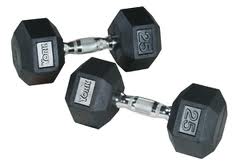
Dumbbells and barbells

The more traditional home workout accessories. Hundreds of exercises can be done with dumbbells and barbells but many people are bored of using them which has led to the huge explosion in popularity for more versatile and fun items such as TRX, kettlebells and ViPR.

You can pick these up in any sports or department store but their weight would make them difficult to travel with. Prices are dependant on quality.

Effectiveness 8   Cost 8   Ease of use 8   Travel-friendly 2   Fun 3

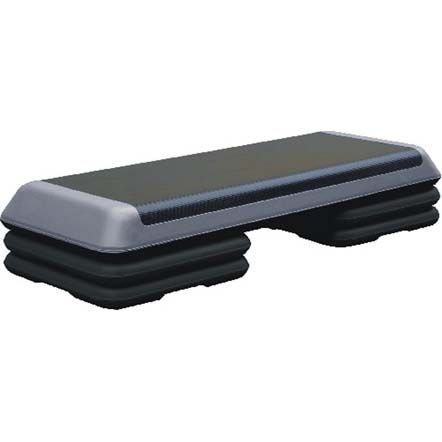
Aerobics Step

Aerobic Steps are simply steps that can be height adjusted. You’ll find them in any gym studio as they’re often used in circuits and aerobics. Many things can be done with step ups but they are essentially just a step, and its use can be largely mimicked with a park bench or a stair.

Effectiveness 7   Cost 7   Ease of use 8   Travel-friendly 2   Fun 4

Ab Roller

The ‘abs’ (abdominal muscles, six-pack) have more pieces of ‘revolutionary’ kit than any other body part. Most of them are horrendously overpriced and packaged with empty promises of a couple of minutes work for a washboard stomach. In summary, a waste of time and money.

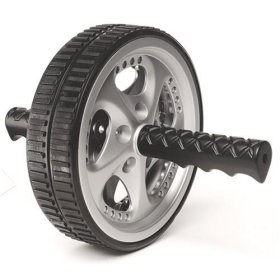
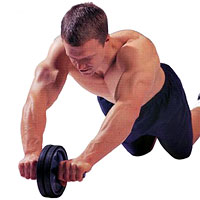
One superb product which targets the abs and is cheap, highly effective and can be stored under your bed is the Ab Roller (also known as an Ab Wheel).

The ab wheel provides a great core workout

Consisting of a wheel with two handles, the ab roller is used by kneeling on the floor, taking grip of the two handles and then the wheel rolling back and forth, using the core muscles to power the movement.

It is quite hard to begin with, and you must ensure you are tensing, engaging and using your abs to power the movement, as otherwise it can put pressure on your lower back. Start with a small range of movement and when you’re comfortable increase the range to make it harder.

They start at about 12USD and can be taken apart easily. The Ab Roller is my favourite piece of kit for working your abs.

Effectiveness 8   Cost 8   Ease of use 6   Travel-friendly 8   Fun 7

You!

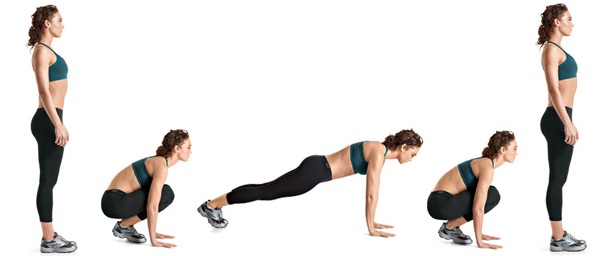
A great and effective workout doesn’t need anything other than yourself. There’s a lot you just using your bodyweight, such as the squat thrust pictured below. The things we’ve mentioned in this article just help make things more interesting and test your body in different ways. We’ll have a look at a workout you can do using just your own bodyweight soon.

Home Workout Kit

There’s a whole host of ideas here that can make training at home much more interesting and varied. Have fun, and let us know how you get on!

Swiss ball and medicine ball combined

Fad diets and nutrition

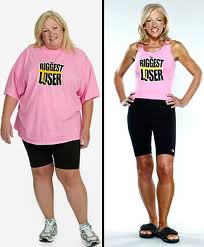
Before and after

Much like ‘get rich quick’ schemes, people like to hear of a magical new diet plan that will have them shedding pounds of fat each day and leave them with a jaw-dropping figure.

But sadly, eating nothing but grapefruit while standing on your head is not the answer.

Whilst many of the ‘latest diets’ might have some initial weight loss results, they are unsustainable, sometimes dangerous and they can slow down your metabolism so that when you resume normal eating the weight piles on just as quick as it was lost.

I’m going to go through some of the most well-known fad diets.

Grapefruit Diet, or one-food diet

There are many one-food diets (egg, cabbage soup etc), with grapefruit being one of the most famous.The diet states you only eat one food and water, so straight away it’s easy to see that the body will be missing many essential nutrients.

Could you only eat this?

As with all fad diets initial weight loss will occur. However, dieting in this way is shown to reduce the body’s metabolism (rate of burning calories), which means that when you start eating other foods again the body burns them slowly and weight is put on quickly. One reason for this metabolism slowdown is that lean muscle tissue is lost during these diets, another huge reason not to do them. Also, food should be enjoyed! Who in their right mind would choose to only eat grapefruit?

The opposite – the body has more lean muscle, is burning more calories even at rest, and you can eat a variety of food is surely more desirable?

High Fibre Diet

States that high amounts of fibre are consumed because fibre makes you feel full and has no calorific value. Many people don’t eat enough fibre so this diet should address that, but the high intake reduces absorption of certain minerals and can lead to mineral deficiency. Abdominal cramps and flatulence are also unpleasant side effects and is a result of your body telling you no.

Liquid Diet

Consists of consuming nothing but liquids. Again, just a low-calorie diet in disguise, resulting in a ballooning in weight afterwards as well as not encouraging healthy and

Cabbage soup? No. Thanks.

balanced food choices. It’s also difficult to maintain with any kind of social life, and your date will think you’re weird if you only eat soup.

Spot Reducing Diet

Any diet that claims to help you lose weight in a specific area (such as the hips and stomach) is a work of fiction. If you lose weight then fat stores all over the body will be lost, usually in the face and neck first. It cannot be ‘targeted’ for loss in certain areas, simple as.

Metabolism Increasing Diets or Pills

The theory is that certain foods will increase metabolism. Some foods will have some effect on metabolism but single foods become tedious and are difficult to eat for a long time. Exercise will have a far larger impact on metabolism than eating a certain food.

Miracle pills such as the ones sold at MBK are useless and dangerous, and you’d be better off eating dirt. Often known to cause strong side effects and even death. They are unregulated and should be avoided like the plague.

Summary

Fad diets don’t work. They aren’t balanced. They aren’t conducive to long-term weight loss. They don’t encourage healthy eating or lifestyle change… But they do sound nice and easy.

The only time a super-low calorie diet is suitable is as a last ditch attempt  to avoid surgery in the extremely obese with body fat % of 40-50. So unless you’re having to be lifted out of bed in a crane, they’re not for you.

The only way to sustainable weight loss is simple: calories consumed < calories burnt, within an active lifestyle.

Sport with friends and family – connect and stay healthy

Whilst the theory is simple, the application often isn’t. It requires a balanced diet, which can still include all the foods you love, as well as a lifestyle change that includes exercise. If lack of exercise is the problem then many things can be looked at such as walking to work instead of driving, taking the stairs instead of the lift, joining sports clubs, working out with a friend, taking classes at home on DVDs or in groups, taking up a new active hobby etc etc… it DOESN’T have to mean slaving away in the gym or on the treadmill.

I’ll leave you with this – most obesity is due to people not doing enough exercise, not because they eat too much. I’ve seen fantastic weight loss from no change in diet at all, just an active lifestyle that includes sport and frequent pulse-raising exercise.

Good luck!